Friday, July 2, 2010

5/21/10 - Cañon del Sumidero y Chiapas de Corzo

After an early breakfast, the group met at the morning meeting to talk about our plans for the day: a trip down the Rio Grijalva through Sumidero Canyon.


Some of the students wondered if we should bring our swimsuits. Professor Tromans responded jokingly, "only if you can out swim a caiman..."


Outside the hotel, we met Juan Carlos, a trusted friend of Professor Tromans for years. When we are in this part of Mexico, we're in Zapatista territory. Outside of the jurisdiction of the Mexican Government, Juan Carlos is not just our driver, but our diplomacy / get us safe passage through roadblocks guy. We'll be traveling with him, in his shuttle-sized bus, quite a bit from here on out.


We drove out and around the mountains of San Crisobal's valley, and onto a side road leading into the forest. After about an hour or so, we arrived at a large boathouse complex in the beautiful Sumidero Ecological Park. After applying copious amounts of sunscreen, all fourteen of us camera-toting gringos donned our fashionable orange life vests and, as gracefully as we could. climbed into the wobbling tour boat.


We passed by a group of Mexican students on a tour through the Canyon :)


The ride was pretty bumpy due to the fact that we were heading against the current. The steep canyon walls and surrounding jungle made for beautiful scenery.


Here and there, our guide would slow the boat to pull over to the side to point out interesting features, like landmarks, a flock of vultures, pelicans, and even a group of baby caimans lounging on a rock!


Mama wasn't far away....


We passed an interesting rock formation called the Christmas Tree. During the rainy season the water cascades down it like a waterfall. This time of year it's relatively dry (for a rain forest) and the formation is covered with moss.


Above it is a creepy pattern in the rock that looks like a face. The ancient Maya called it "the profile."


We pulled into a cave, called the "cave of colors," because of the beautiful pink and yellow streaks running through the limestone walls. Inside was a small shrine to the Virgin Mary of Guadalupe, with a ladder leading up. On the wall next to it was a plaque dedicating the shrine to the Canyon's early explorers and wildlife conservationists.


One of the most striking features of the tour was a cliff that is supposedly the highest point in the canyon. Legend has it that the local people, rather than be enslaved by the conquering Spaniards, jumped off this cliff to their deaths in the river below.


This cliff and the one opposite it form a silhouette that is featured on the State of Chiapas Coat of Arms.


The ride back was down river and super fast, but we did stop for a while to observe some monkeys swinging through the canopy! Professor Tromans, who was sitting next to me, turned to me and said, "Lilly, what kind of monkeys are those?" "Spider monkeys," I said, to which he replied (somewhat suprised), "Yes! They have a prehensile tail." I nodded and couldn't wipe the smile off my face, for having the chance to demonstrate that I actually DID pay attention in his anthropology class last semester.


After the boat ride, Juan Carlos drove us to the nearby city of Chiapas de Corzo. Standing in the middle of the town square is a huge gazebo-like arch, built during colonial times to represent the queen of Spain's crown.


Here, the local Chiapanecan Indians hold festivals, performing dances honoring their history. They are particularly proud of their status as the only Mayan tribe who never surrendered to the Spaniards. Emeliano Zapata, the revolutionary from whom the Zapatistas take their name, was born here.


Another source of cultural pride here is the marimba, a xylophone-like instrument that originated here. As we were walking through town, we stopped and watched two men playing a catchy, happy, tropical-sounding song on one. The sound of the marimba is something between a steel drum and a piano.


The guy standing on the side was collecting tips... :D


We passed by some little shops displaying some of the traditional decorations and clothing of the Maya in this area.


In the picture to the right, the two outfits on the right are the clothing of the Lancondon, who live in the rain forest. They are the ONLY Mayan tribe that was not found by the Conquistadors. They remain untouched, to this day, by Spanish influence. We'll be visiting them in a few days, I am SO EXCITED.


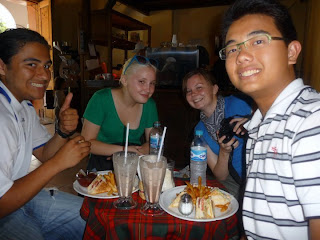
We stopped for lunch at a small restaurant, and were greeted by a friendly woman wearing a traditional embroidered dress, head scarf, and radiant smile. As Sam, Howie, Naylynn, Chelsea, JoAnn and I say down, we were a bit surprised to be handed a hand-written menu on a notebook page! We soon realized that this restaurant was actually the front room of a family's house. I asked for bottled water, and the woman actually went across the street to the Oxxo, bought a bottle, and brought it back for me! The food was amazing, and it really felt like we were guests, enjoying to the fullest this Mom-cooked meal, complete with plastic Spider-Man plates.


While we were eating, the young girl who lived there came home with her pink backpack and gave her mom a big hug. She sat on her lap and excitedly narrated her day at school while her mom held her and smiled. It was a heartwarming moment, and a stark contrast to the scene outside of two police officers strolling by on the sidewalk with shotguns. Yet another reminder of the oppressive apartheid system that has existed here for centuries, and is only recently starting to disappear, largely due to the social reformation efforts of the Zapatistas.


Tuesday, June 29, 2010

5/20/10 - The Village of Chamula

It felt amazing to sleep in a comfortable bed last night, and to wake up refreshed by the cool mountain breeze swirling in through our hotel's windows. It was such a stark contrast to the hotness and humidity of both Merida and Florida, and truth be told it almost felt like being back in Idaho, where I grew up! We had a lovely breakfast at the hotel this morning, then a quick meeting before setting off for the village of Chamula. We rode there in a cambi -- a small van, basically, which transports to and from a specific destination for a flat rate. They can be found in many places around town, usually near the market. All fourteen of us piled into one, plus a few people, which is pretty much the norm, and off we went!


We arrived in the village square, where a sizable crowd was gathered around a raised platform like a stage. Some of the local children were performing what appeared to be a healing ceremony, from what we could decipher of the banner hung above the stage. The kids were dressed in the traditional clothing of the highland Mayas: the girls with flowers in their hair, wearing embroidered blouses and black wool skirts secured around their wastes with colorful scarves; the boys wore white wool tunics, belted over trousers and a shirt. Ribbons of smoke swirled out of little pots of incense lining the front of the stage, as the kids chanted prayers in the Mayan dialect of Tzotzil while moving through a process of choreographed gestures. When they were finished, the crowd clapped and cheered, and the kids beamed with pride as they waved to their parents below.


It suddenly strikes me that in these people's history there have been others to come here and witness beautiful examples of community tradition like this one, and failed to see anything past the closed-minded notion that these people are different, and different is unacceptable. They called them "pagan," and used that word as justification to steal from, murder, and enslave them.


Despite this disturbing history, Chamula culture is still very much alive. On the town square stand the colorful Iglesia de San Juan Bautista, originally a Spanish mission church but is now an interesting blend of Catholicism and traditional, pre-conquest Mayan religion. Inside, cameras are not allowed. We walked in, silently, keeping our eyes down lest we look a Shaman in the face (this is considered very disrespectful). The floor is covered with pine needles, traditionally to represent the Mayan tree of life, but if you ask anyone they'll tell you they are to signify that Christ died on a pine cross. There are no pews. People kneel on the floor, chanting prayers in Tzotzil Mayan in front of rows of colored candles stuck to the floor with melted wax. Each color of candle represents a different thing such as sickness, the spirit, the soul, luck, purity, or the evil eye. They are prescribed by a shaman to treat a range of afflictions. Traditionally, worshippers would drink a fermented drink called posh, the subsequent burps believed to be the body releasing evil influences. Nowadays, posh has been largely replaced by soda -- particularly Coca-Cola. For particularly severe problems, a live chicken is sacrificed. We saw two chickens being sacrificed inside. Lining the walls are statues of Saints, their facial expressions full of emotion. They are now incased in glass for protection, as in the past they have been vandalized by people whose prayers have gone unanswered.


Outside the church, people send up their prayers in the form of bottle rockets. Traditionally, the Chamula live in thatched-roof huts. Occasionally, a firework will come back down and set one on fire. In recent years, the thatched roofs have slowly started to be replaced by tin ones.


The Chamula are an agricultural society, and their main staple is corn. This climate is relatively stable, so they can grow corn year round -- and they have been for thousands of years.


One of the problems that plagues the people here is protein deficiency in children. To treat this issue, a Shaman will take the sick child to different stations around down. Kneeling before the monumental crosses, they burn incense and chant prayers. At the last station, they sacrifice a chicken. The chicken is cooked and then eaten by the child and the Shaman, effectively solving the problem.


Crosses were important to the Maya long before Christianity ever came here. They represent the five cardinal directions: north, south, east, west, and center. This is also what the pyramids represent. Many crosses are adorned with pine branches, traditionally representing the mayan tree of life. You see carvings of trees with branches pointing in the shape of a cross at a lot of Mayan sites.... fortunately for them, it was a good way to fool the missionaries who otherwise might have made it harder on them. Fortunately for the missionaries, the conversion process was much easier, considering they were able to associate this and other familiar symbols with unfamiliar concepts. Some other examples: the moon, which to the Maya has for centuries represented the goddess of the underworld, the mother of fertility, to the crops and to the people, who gives life and takes it away, becomes representative of Mary as well; the sun, the father god and representative of the king, becomes Jesus. Sacrifice, something so important to the Maya, becomes embodied by the crucified Christ. Judas is not scorned for his betrayal, but commended -- for taking responsibility for his actions. For maintaining his dignity by killing himself, rather than be killed by another or dying of old age which would have been a continuation of his selfish ways.


These are all examples of what anthropologists call syncretism: the blending and overlapping of different schools of thought, particularly as relating to religion, between a dominant culture and an oppressed culture. Here's a quick, good article on Mayan religion, and some of the ways it has incorporated / interpreted traditional Catholicism.


We spent the day at the village, exploring the streets and beautiful countryside. I had some fun at the market, bartering and communicating as best I could with people with whom our only link in communication was the bits and pieces of Spanish we both knew. . . :D I did manage to buy a pretty awesome bag, and a rosary for my mom. For lunch we had some delicious fire-grilled corn, seasoned with spicy salt and lime, bought from a small market stand.


We headed back to San Cristobal as it was starting to get dark. When we got back, Yoshi, Howie, Sam and I decided to go to out for milkshakes and discovered an awesome little shop on the Zocolo called Cafe Yik. As we were sitting, three young boys came in and, pulling small ceramic animals out of their baskets, they laid them out one by one on the table, "elefante, jaguar, tortuga.....," I bought one from each of them, for three pesos each, only to be scolded again by Howie, who thinks I'm much too easily chided by the cute small ones. (He's probably right...!)


Monday, June 28, 2010

5/18/10 - 5/19/10 - Depart Merida, Arrive San Cristobal

Tonight we embark on a twelve-hour bus trip, across the plains of northern Yucatan, down through Tobasco, and into the mountainous cloud forest of the southern Chiapas highlands. We'll wake up in the city of San Cristobal de las Casas.

Our Caribe breakfast was somewhat sentimental -- we have come to think of this place as home, and even though we will be coming back here a few days before we leave Mexico, we'll miss the familiarity, and the warm, friendly, inviting atmosphere of Merida that we've grown so attached to.


Saying "goodbye for now," to the Hotel Caribe


After the morning meeting, Yoshi and I went for a walk around town, our mission being to acquire foodstuffs, beverages, and batteries to sustain us on our overnight journey. While we were out, we ran into our friend Ricardo again! We were actually in quite a hurry, but we told him we would undoubtedly be visiting his shop as soon as we get back to Merida. We headed back to the Caribe to pack our bags. The plan was to separate what we wanted to take with us to San Cristobal from what we wanted to leave in Merida, like clothes, money, souvenirs, etc. The things staying in Merida would be locked in Professor Tromans' room at the Caribe for safe keeping while we were gone, and had to be given to him no later than 12:30 pm. Typical of myself, I lost track of time, and there I was at 12:31 knocking on Tromans' door, and him not answering. I sighed, and resigned to myself that I'd be taking the extra bag with me!

We'd be leaving on a bus from the ADO station at 7:00 pm, and we were expected to get ourselves there no later than 6:00. It was starting to rain, and fearing the possibility of another flood, Yoshi, Naylynn and I decided to catch a cab to the station at 5:00. We stood out in the rain by the taxi stand in front of the Caribe holding our bags for a good fifteen minutes, trying in vain to flag over a cab as one after the other passed us by. Finally, a man ran over to us from across the street, grabbed a few of our bags and shouted down a taxi for us. He helped us load our luggage into the cab, and wished us a safe journey. Such nice people here!

We got to the ADO station ridiculously early, of course, and our group members trickled in in groups of two or three over the next hour (many of them, like us, soaking wet from the rain). We played cards, listened to music, and talked to pass the time.


Professor Tromans: "This is my best angle."
Finally, when we were all there, we checked our bags to be stored under the bus, and boarded. Professora Sahagun passed around a bottle of Dramamine to prevent carsickness, with the underlying assurance that it would more or less knock us out cold. The bus driver popped in a movie, "The Boy in the Striped Pajamas," which was a complete tear jerker despite my inability to understand most of the dialogue, as it was dubbed over in Spanish. That's the last thing I remember before I dozed off.


I woke up a few hours later when the bus stopped for a break at a station in some town along the way. I had no idea what time it was or for how long we had been driving, but I do remember that it was dark outside as I stumbled off the bus, still drowsy from the Dramamine. I went up some stairs to where there was a public bathroom. Like all public bathrooms in Mexico, this one cost two or three pesos to go into. It had a coin slot attached to a revolving gate with horizontal metal bars. I put in my coins, and pushed through the gate, somehow getting my right ankle caught in the bars and tripping my way in. As I limped back to the bus, I realized my ankle was hurting. A LOT. I sat down and rolled up my pants to reveal a gigantic goose egg. My entire ankle was blue and purple all the way around. I showed Howie, who exclaimed "What the heck happened?" My sleepy reply: "The baño tried to eat me!" (Baño is Spanish for bathroom). In chimed Naylynn with, "MMMM, GRINGA! OMNOMNOMNOMNOM," all of us busting out laughing until our sides hurt. This incident has become the leading running joke, complete with a giant purple swollen ankle to illustrate :D


. . .

5/19/10

I woke up this morning on the bus just before the sun appeared. All I could see were the dark shapes of trees, and further off dark blue mountains covered in fog. Here and there in the distance small groups of lights indicating where homes were, and people were just getting up, having breakfast before they start work at first light. The smell of cooking fires was making my stomach grumble. I was one of the only ones awake, and as my swollen ankle throbbed uncomfortably I just sat looking out the window in awe. It was so surreal, and beautiful.


We drove deeper and deeper into the jungle, and just as the sun began to peak out from behind the mountains we passed through a village.  Men, women and children were out working in their corn fields. We passed a sign saying, from what I could make out in Spanish, “This area supports Zapatista,” or something to that effect. I was thinking, “Wow... this is it!”


We kept driving for what seemed like forever, into what seemed like the middle of nowhere, surrounded by thick jungle broken only by the occasional corn field or small village. We bounced along the mountain road, shifting from side to side with every turn. There was a bathroom in the back of the bus -- not the most pleasant smelling place in the world, but I was desperate. So I made my way back there, bracing as the bus tipped and tossed. I closed the door to the tiny bathroom, only to realize the door didn't latch. So as I sat and went about my business, I held the door shut with my left hand. As the bus began again to lurch and swing, I found myself clinging to the door handle for dear life, fearing that it would fly open and appall the Sisters who happened to be sitting right outside the door! Mexico has so far managed to give me the most adventurous bathroom experiences I've ever had. Naylynn actually succeeded in manhandling the door locked on her turn, except when she was done she couldn't get it unlocked. Ay carumba. . .!

As we were finally nearing the city, we found ourselves running into a traffic jam along the mountain road, specifically the only road leading in and out of San Cristobal. Apparently, part of the road had washed out during the night. Our bus stopped and we waited for almost two hours as the cars piled up behind us. Sweating to death in the hot bus, we waited and waited as a construction crew worked on an emergency repair. Our twelve hour trip was now looking to become a fifteen hour trip. Finally, they began letting cars through. We watched as car after car from the opposite direction went through, the cars on our side honking and shouting. Some tried to force their way through, and more than once we feared one of them would run the other off the edge of the cliff!


A family stood outside their home nearby and watched with interest, to add to the huge crowd that was gathering to watch this exciting event!


The little boy on the left was very concerned...


We watched as a bus about the same size as ours pulled up, unloaded it's passengers who walked behind as the bus nervously wobbled around the slippery bend. Then, it was our turn. We stayed on the bus as it leaned around the bend in the dirt road. On my side, I could see nothing but a sheer drop into the jungle, and I honestly feared for my life for about ten horrifying seconds until we finally made it around to safety. The entire bus let out a collective sigh of relief as we drove into the city.


The city of San Cristobal is a hidden gem situated in a valley in the middle of the jungle, with only a few small villages around it. It's at least twelve hours from any other major city. It's hard-to-reach-ness makes it a place where Americans rarely venture. It's a popular haven for backpackers, mostly European, who are embraced with open arms by the multitude of hostels found around the city. In 1994 the city was stormed by Zapatistas and, like most of the surrounding country, claimed as part of their territory, independent of Mexico and outside of the jurisdiction of the Mexican government. Many people here openly support the Zapatista movement, which aims to restore land rights to the indigenous people, who make up 90% of Mexico's population yet own less than 50% of the lowest quality of farmland.


After arriving at the bus stop and claiming our baggage, we set out into the city to walk to our hotel. It wasn't so much of a walk as it was a hike, uphill and downhill over jagged and uneven sidewalks and slopes, up and down curbs that for whatever reason are about two feet higher than the road, carrying our heavy bags.


It was intense, to say the least. We trekked for six blocks until we finally reached the hotel, only to find that they had "lost" our reservations!


Our frustrated professors negotiated with them, until they finally got us a deal with a sister hotel, about five more blocks away. Luckily, this time we got a truck to take our bags!

We finally made it to the beautiful hotel, and soon discovered a ladder leading up to a skylight right outside our rooms and up onto the roof. It was a gorgeous view from up there, and it was at that moment I decided that this city is a spectacular rarity, and officially at the top of my list of favorite places.


I can't wait to do some exploring! But first, a shower. . .